Yuhang Wang

ADAS-TO: A Large-Scale Multimodal Naturalistic Dataset and Empirical Characterization of Human Takeovers during ADAS Engagement

Yuhang Wang, Yiyao Xu, Jingran Sun, Hao Zhou
University of South Florida · MOTIF-Lab
IEEE International Conference on Intelligent Transportation Systems (ITSC 2027)
ADAS-TO dataset overview

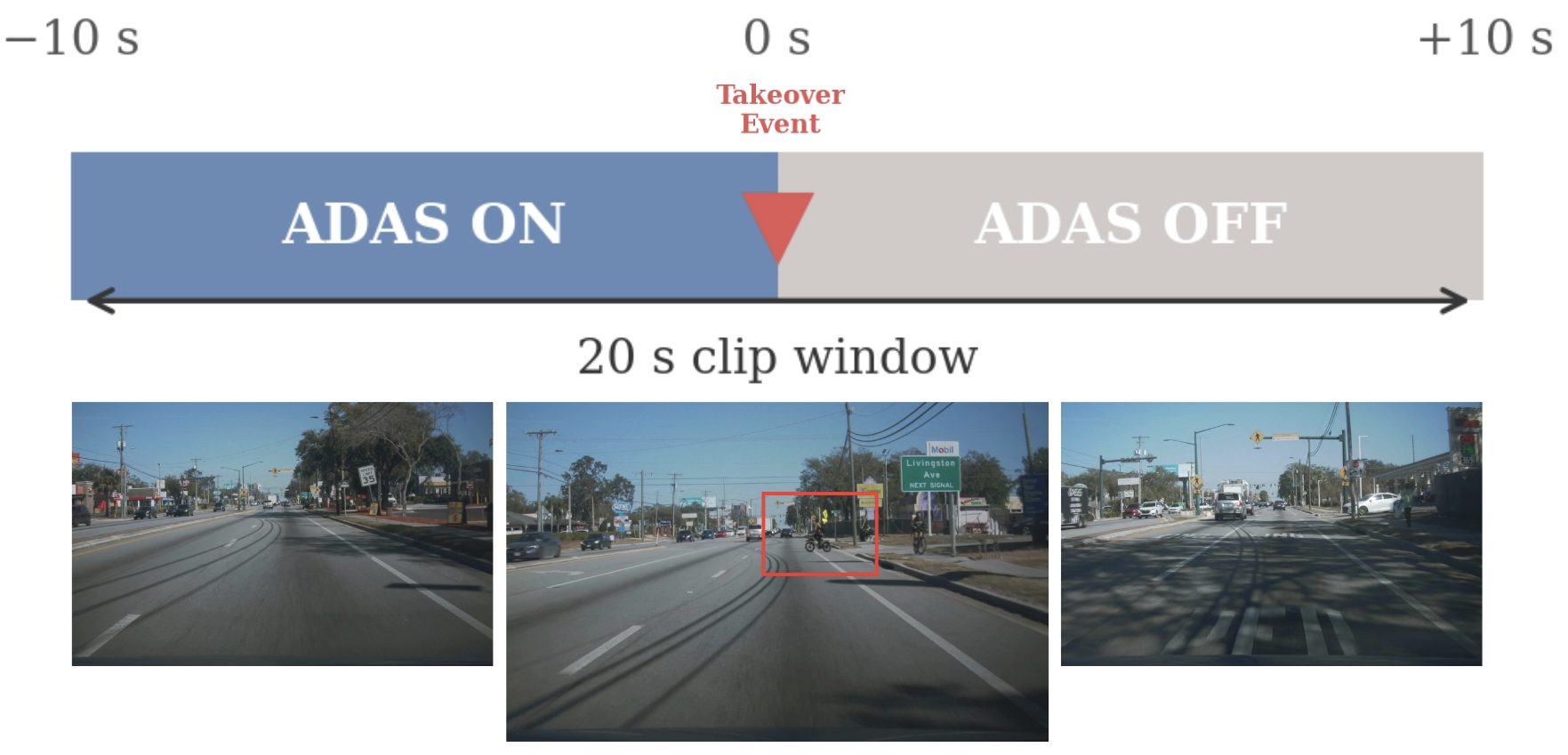
15,000+ real-world takeover events capturing the moment drivers reclaim control from automated driving systems.

15,659
20-s clips
327
drivers
22
vehicle brands
285
safety-critical

Abstract

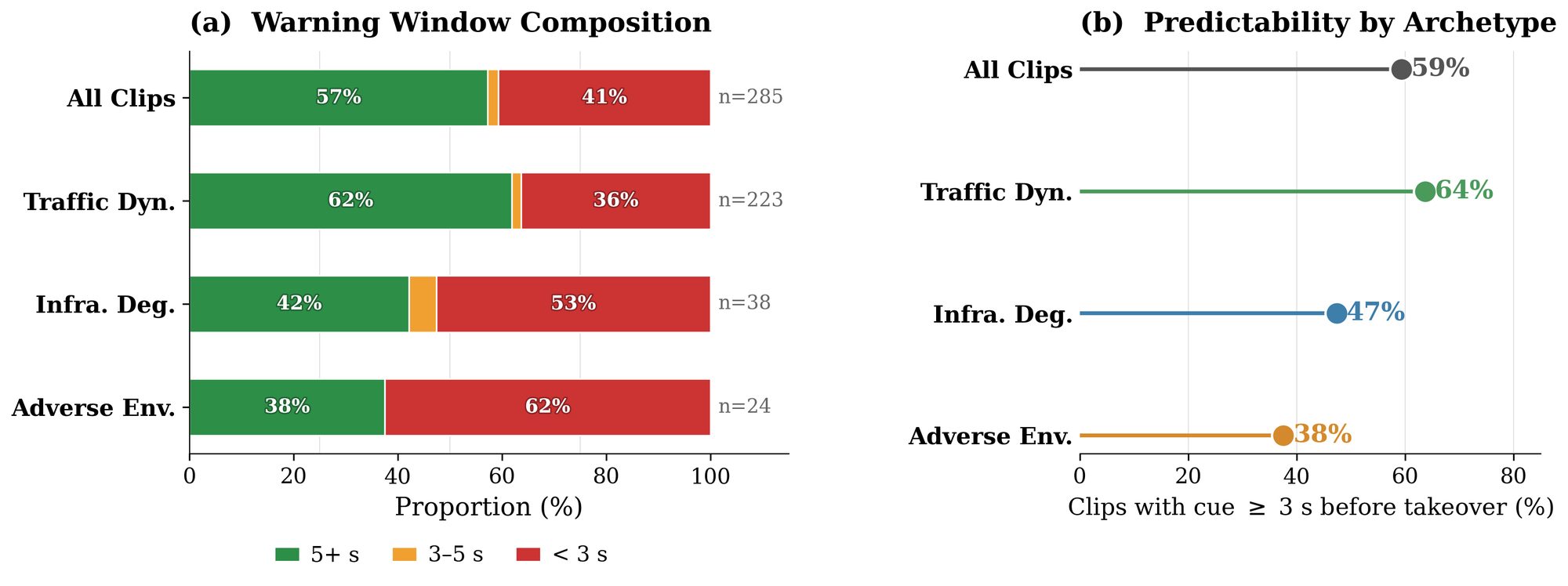
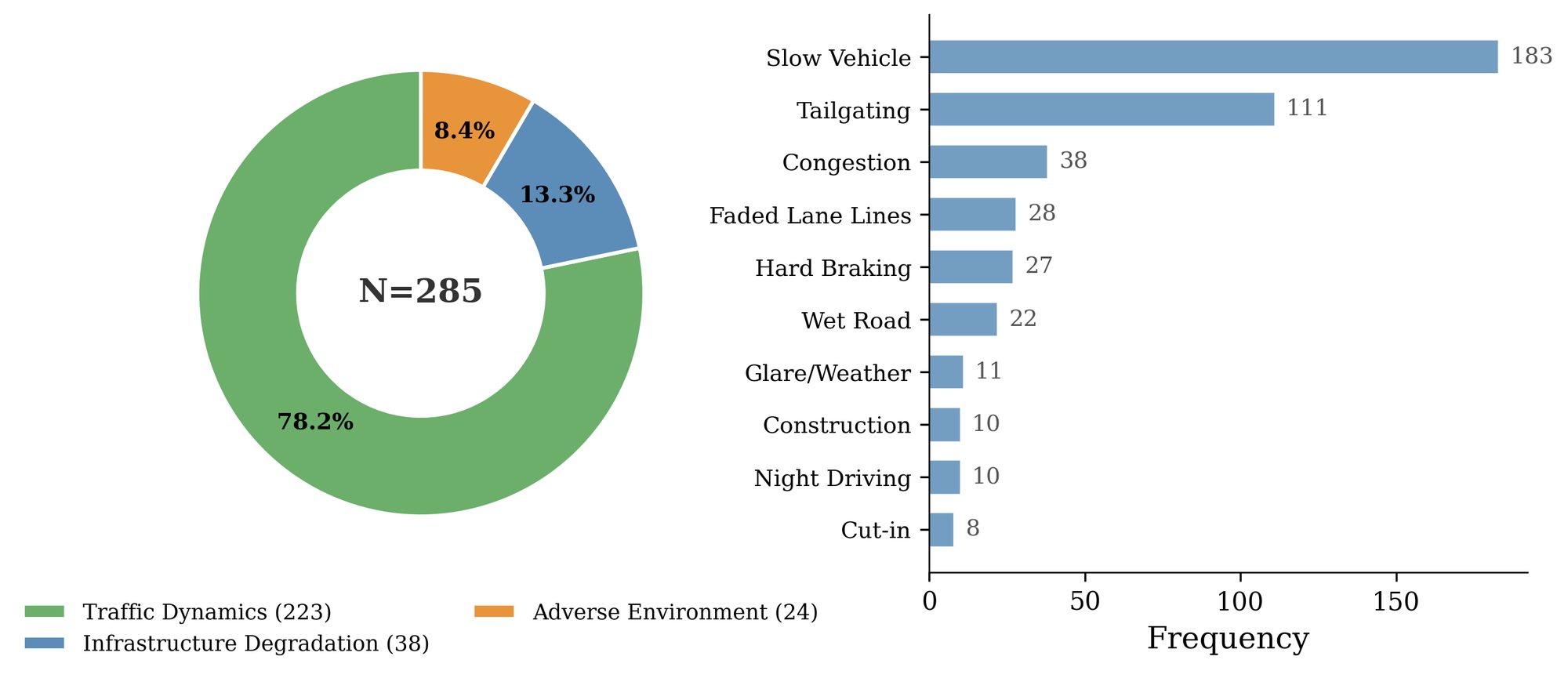
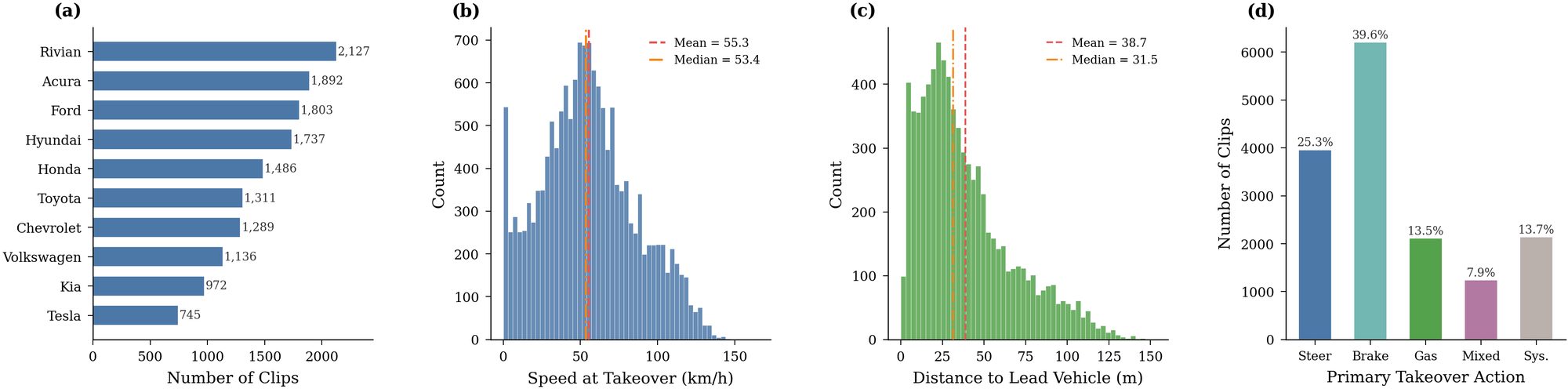
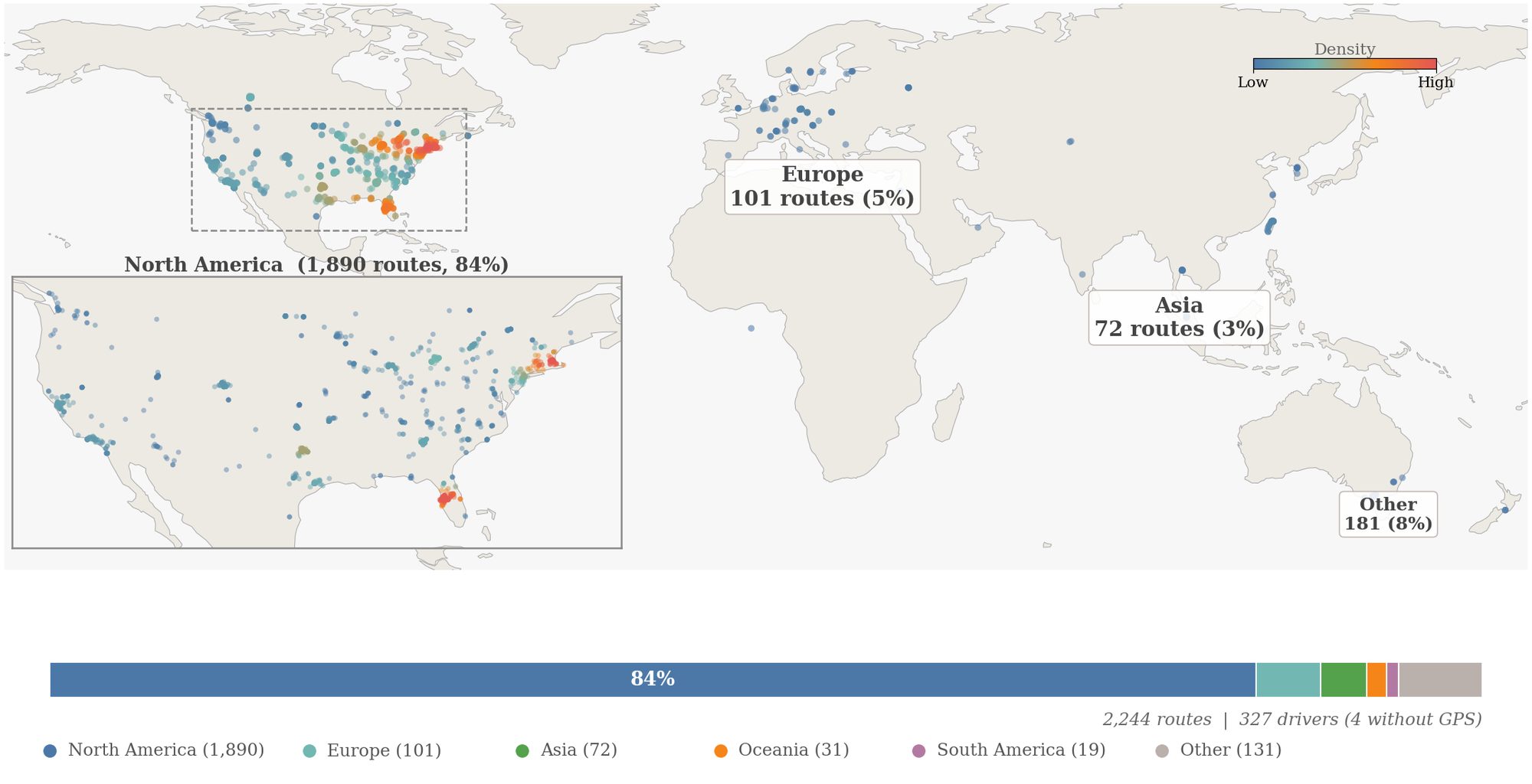
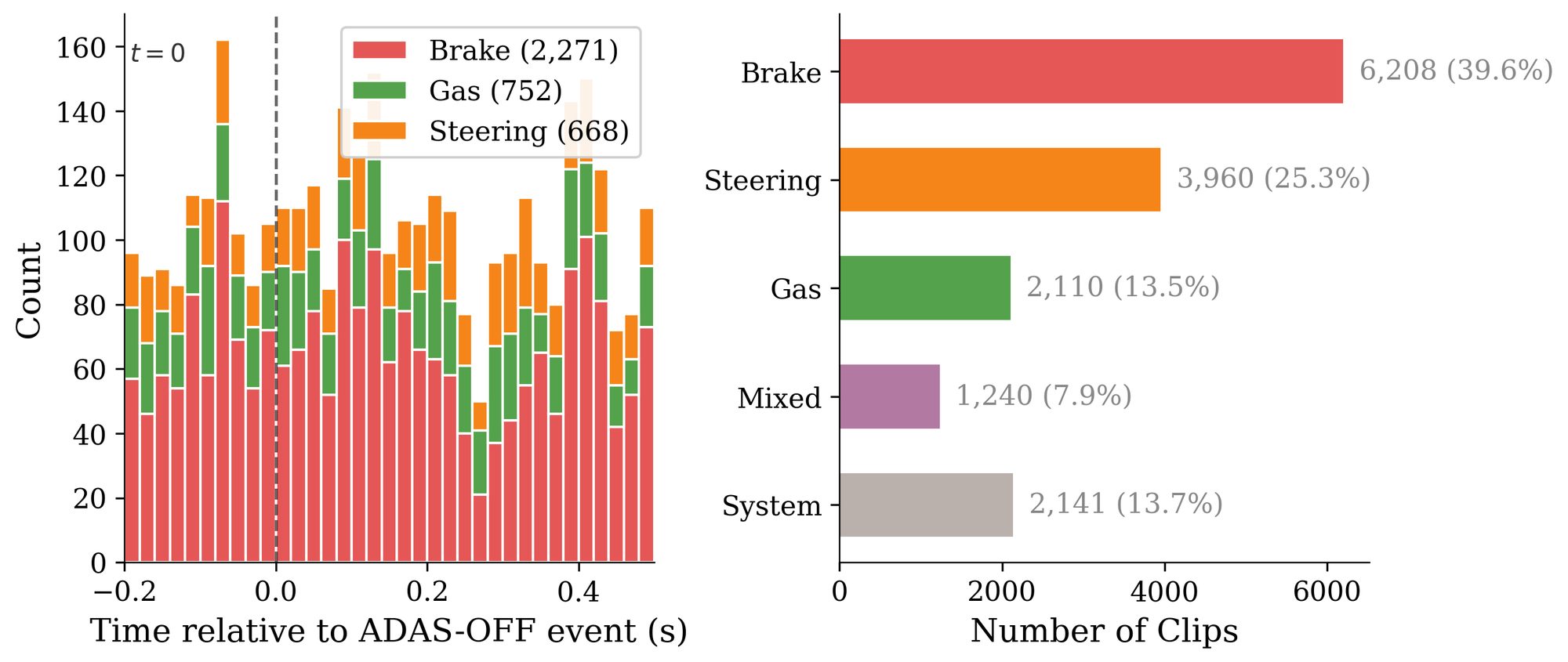
ADAS-TO characterizes transitions from Advanced Driver Assistance Systems (ADAS) back to manual control. It comprises 15,659 twenty-second clips from 327 drivers across 22 vehicle brands, each synchronizing front-camera video with vehicle logs. Takeovers are categorized by trigger — brake, steering, accelerator, combinations, and system disengagement — and by whether they were driver-initiated or forced. Our analysis identifies 285 safety-critical cases and, by combining vehicle kinematics with vision-language-model annotations, finds that actionable visual cues emerge at least three seconds before takeover in roughly 60% of critical events. ADAS-TO provides a rich, multimodal foundation for studying human–automation handover and building predictive take-over warning systems.

Take-over Scenarios

Representative real-world moments where drivers reclaim control.

Truck cut-in
A truck cutting in ahead.
Rapid closing
Rapidly closing on a slower lead vehicle.
High severity
A high-severity safety-critical event.
TTC drop
A sudden drop in time-to-collision.
Jeep cut-in
An adjacent vehicle merging abruptly.
Close vehicle
Close following in dense traffic.

BibTeX

@inproceedings{wang2027adasto,
  title     = {ADAS-TO: A Large-Scale Multimodal Naturalistic Dataset and Empirical Characterization of Human Takeovers during ADAS Engagement},
  author    = {Wang, Yuhang and Xu, Yiyao and Sun, Jingran and Zhou, Hao},
  booktitle = {IEEE International Conference on Intelligent Transportation Systems (ITSC)},
  year      = {2027}
}